How to Grill a Turkey for Thanksgiving: Spatchcock Method, Times & Temperatures
Yes — you can grill your Thanksgiving turkey, and a spatchcocked bird is the fastest way to do it well. Cut out the backbone, press the turkey flat, and a 14-pound bird cooks in about 80 to 90 minutes at 375°F over indirect heat, with evenly cooked breast and thigh meat and skin that actually crisps. A whole bird on the grill takes two to three times as long and dries out the breast while the thighs catch up. This guide covers the full method: the dry brine, the grill setup for gas and charcoal, exact times and temperatures by weight, and a real hour-by-hour Thanksgiving Day timeline for a 14-pound turkey.
KEY TAKEAWAYS
- Spatchcock the turkey: it cooks in roughly half the time of a whole bird and the white and dark meat finish together.
- Grill at 350–400°F over indirect heat. A 14-pound spatchcocked turkey takes about 80–90 minutes; a whole bird the same size takes 2.5–3 hours.
- Pull the breast at 157–160°F and the thigh at 170–175°F. Carryover heat brings the breast to the USDA-safe 165°F during the rest.
- Keep the lid closed and use a leave-in probe thermometer — every peek costs 25–50°F of grill heat.
- Rest the bird 20–30 minutes before carving. Do not skip this.
Why Spatchcocking Works So Well on the Grill
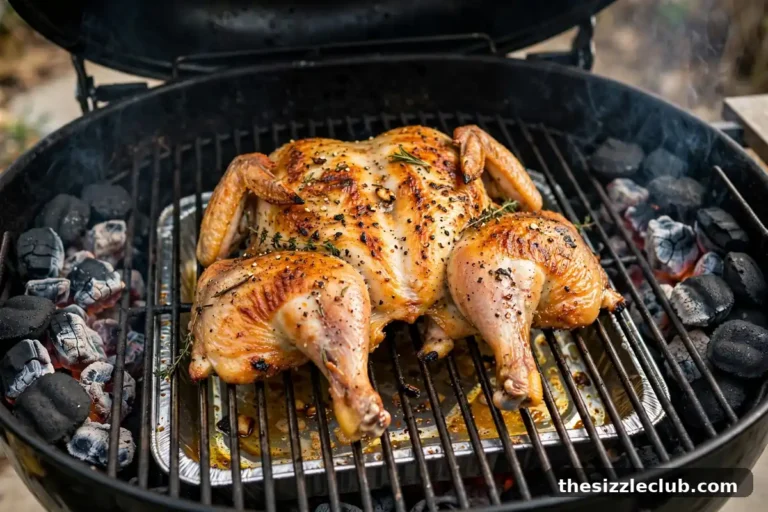
A whole turkey is an awkward shape for a grill. The breast sits high and exposed while the thighs hide low near the heat, so the breast overcooks before the thighs are safe to eat. Spatchcocking — removing the backbone with kitchen shears and pressing the bird flat — fixes the geometry. The legs and breast end up on the same horizontal plane, the same distance from the heat, so they cook at the same rate. It also cuts the vertical height of the bird roughly in half, which matters because many grill lids will not close over a tall whole turkey.
The time savings are real. At 375°F over indirect heat, a spatchcocked 14-pound turkey finishes in about 80 to 90 minutes. The same bird left whole needs 2.5 to 3 hours. That shorter cook means less time for the breast to dry out, and the flattened bird exposes far more skin to the heat, which is why the skin comes out golden and crisp instead of pale and rubbery.
There is one more advantage nobody talks about: a spatchcocked turkey frees your oven entirely. On Thanksgiving, the oven is the bottleneck — the stuffing, the casseroles, the rolls all need it. Moving the turkey outside ends the scheduling war in the kitchen.
What You Need Before You Start
You do not need special equipment, but three things are close to mandatory.
First, a leave-in probe thermometer, ideally a wireless one. You will check doneness without lifting the lid, and that alone can save you 20 minutes of cook time. An instant-read thermometer as a backup is smart, but the leave-in probe is the tool that turns guessing into a number on your phone.
Second, a pair of sturdy kitchen shears. Cutting through a turkey’s backbone and rib bones with a knife is miserable work. Good shears make it a two-minute job.
Third, a rimmed baking sheet with a wire rack. You will use it for the overnight dry brine, and then as the tray that carries the bird to the grill.
Before you buy the bird, measure your grill. A spatchcocked 14-pound turkey spreads to roughly 18 inches across. It needs to lie flat with at least an inch of clearance on every side so hot air can circulate. On a standard 22-inch kettle grill, that fits. On a small two-burner gas grill, a 12-pound bird is the practical maximum. If the bird is too big, buy smaller — a 12-pound turkey that fits beats a 20-pound one that does not.
How big a turkey do you need?
Plan on about 1 to 1.5 pounds per person. A 12-pound turkey feeds 8 to 10 people, a 14-pound bird feeds 10 to 12, and a 16-pound bird feeds 12 to 14. Buying bigger than your grill can hold is the single most common grilling mistake on Thanksgiving, so check the fit before you commit.
Prep the Day Before: Dry Brine and Spatchcocking
Do this 24 to 36 hours before you cook. The dry brine is just salt, and it is the highest-return step in this entire guide.
Start by spatchcocking. Place the turkey breast-side down on a cutting board. With kitchen shears, cut along one side of the backbone from tail to neck, then cut along the other side and remove the backbone completely. Save it — it makes excellent stock or gravy. Flip the bird breast-side up, place both palms on the center of the breastbone, and press down firmly until you hear a crack and the bird lies flat. Tuck the wingtips behind the breast so they do not burn.
Now the dry brine. Pat the turkey completely dry with paper towels, then sprinkle kosher salt evenly over every surface, including under the skin of the breast where you can reach it. Use about 1 tablespoon of kosher salt per 4 pounds of turkey — roughly 3.5 tablespoons for a 14-pound bird. Place the bird on the wire rack over the rimmed baking sheet and refrigerate it uncovered for 24 to 36 hours.
The uncovered rest matters as much as the salt. The salt draws moisture out, dissolves into it, and is pulled back into the meat, seasoning it all the way through. Meanwhile the dry fridge air dries the skin surface, and dry skin is what crisps on the grill. A wet-brined or unbrined bird will steam under its own moisture and give you soft, pale skin.
On the morning of the cook, take the turkey out of the fridge an hour before it goes on the grill. Brush off any visible salt clumps, pat it dry once more, and rub it all over with a thin coat of oil and your seasoning — a simple mix of black pepper, garlic powder, and dried herbs is enough. Do not add more salt; the brine already handled that.
Setting Up the Grill: Gas vs Charcoal
Both gas and charcoal work. The principle is identical either way: a two-zone fire with the turkey cooking over indirect heat, never directly above the flames.
On a gas grill
Preheat all burners on high for 10 to 15 minutes with the lid closed. Then turn off the burner or burners directly under where the turkey will sit, and leave the outer burners on medium. You are aiming for 350 to 400°F inside the closed lid. Place a disposable aluminum drip pan on the turned-off burner grate, directly under the bird, and add a cup of water or stock to it — this catches the drippings for gravy and keeps them from burning and smoking. Set the turkey on the grate over the drip pan, breast-side up, with the legs pointing toward the hotter side of the grill.
On a charcoal grill
Light a full chimney of charcoal — about 80 briquettes. When the coals are covered in gray ash, bank them to one side of the grill (or split them to both sides with an empty channel down the middle). Place the drip pan in the empty zone and the turkey over it, legs toward the coals. Put the lid on with the top vent positioned over the cool side, which pulls the heat across the bird. Adjust the bottom vent to hold 350 to 400°F. Expect to add a half chimney of fresh coals after about an hour if you are cooking a bird over 14 pounds.
The fuel check most people skip
A standard 20-pound propane tank holds about 4.6 gallons of fuel. At the moderate heat you need for a turkey, a typical three-burner grill runs roughly 18 to 20 hours on a full tank, so a three-hour turkey cook uses about 15 percent of a tank. That sounds comfortable until you remember the tank was not full when you started. If your tank feels light or is below a quarter full, swap it before you light the grill. Running out of gas with a half-cooked turkey is a Thanksgiving disaster with no good fix — you cannot finish a bird in a cold oven on schedule.
Grilling Times and Temperatures by Weight
Use the clock to plan your day and the thermometer to decide when the bird is done. These are indirect-heat estimates at 350 to 400°F on the grill. Wind, cold air, and lid-lifting all add time.
| Turkey Weight | Spatchcocked | Whole Bird, Indirect Heat |
|---|---|---|
| 10–12 lbs | 50–70 minutes | 2–2.5 hours |
| 13–15 lbs | 70–90 minutes | 2.5–3 hours |
| 16–20 lbs | 85–110 minutes | 3–4 hours |
| 21 lbs and up | Not recommended — most grills cannot lay a bird this size flat | 4–5 hours |
Two rules govern the table. First, always confirm with a thermometer — no time estimate survives a windy day or a grill that runs cool. Second, a spatchcocked bird cooks at roughly 10 to 12 minutes per pound at 350°F, so you can estimate any size in between: a 13-pound bird lands around 80 minutes.
The Thanksgiving Day Timeline: A Worked Example
Here is the real schedule for a 14-pound spatchcocked turkey with dinner at 2:00 PM. The bird has already been dry-brined overnight.
The day before, evening: Spatchcock the turkey, salt it, and put it on the rack in the fridge uncovered.
10:30 AM: Take the turkey out of the fridge. Pat dry, oil, and season. Let it sit at room temperature while you set up the grill.
11:00 AM: Light the grill. On gas, preheat all burners on high. On charcoal, light a full chimney. While it heats, put the drip pan in place with a cup of water or stock.
11:30 AM: Grill is at 375°F. Set the burners for indirect heat, place the turkey breast-side up over the drip pan, insert the leave-in probe into the thickest part of the thigh, and close the lid. Do not open it again until the probe tells you to check.
12:30 PM: About an hour in, the breast should read near 130°F and the thigh near 150°F. On charcoal, add a half chimney of coals now if the grill temperature is falling.
1:00 PM: The breast should reach 157–160°F and the thigh 170–175°F. Pull the bird. Total cook time: about 90 minutes.
1:00–1:30 PM: Rest the turkey, tented loosely with foil, on a cutting board. The breast will climb to the safe 165°F from carryover heat. This is when you make the gravy from the drip pan.
1:30 PM: Carve and serve. Dinner is at 2:00 PM with half an hour to spare.
If dinner is later, shift the whole schedule. The structure stays the same: turkey on the grill 2.5 hours before serving, pulled 30 to 45 minutes before carving.
Cold Weather and Wind: Adjusting on the Fly
November grilling is cold-weather grilling, and the weather is the variable most recipes ignore. Wind is the biggest factor: it can pull 25 to 50°F off your grill’s internal temperature. A grill holding 375°F on a calm day may sit at 325°F in a stiff breeze, and your cook time stretches by 20 to 30 percent.
Set up with the wind at your back so it does not blow straight into the vents, and park the grill in the most sheltered spot you have — a fence or the side of the house makes a real difference. In temperatures below 40°F, preheat five minutes longer and budget an extra 15 to 20 minutes of cook time for a 14-pound bird. In rain, a grill under a covered patio or a pop-up canopy keeps the temperature steady; never grill inside a garage or under a low roof, where carbon monoxide collects.
Do not compensate by cranking the heat. A grill at 450°F will scorch the skin long before the thigh is done. Hold your target temperature and let the thermometer, not the clock, call the finish.
How to Tell When It’s Done
The USDA safe minimum internal temperature for turkey is 165°F (74°C) in the breast, thigh, and any stuffing. But the number on the grill and the number on the plate are not the same, because a big bird keeps cooking after it leaves the heat. This is carryover cooking, and it works in your favor.
Pull the turkey when the thickest part of the breast reads 157 to 160°F. During a 20 to 30 minute rest, carryover heat will bring it up to 165°F or slightly above. The thigh is different: dark meat tastes best at 170 to 175°F, where the connective tissue has softened. Because the spatchcocked bird cooks evenly, the thigh usually reaches that range at about the same time the breast hits its pull temperature — if the thigh is lagging, leave the bird on another 10 minutes; the breast will still be fine.
Probe placement matters more than probe quality. Push the probe into the thickest part of the thigh without touching bone, because bone conducts heat and reads hotter than the meat. Check the breast separately with an instant-read thermometer in the thickest part, again avoiding bone. If you only measure one spot, measure the thigh — it is the slowest part of the bird and the one that determines food safety.
Resting and Carving
Rest the turkey for 20 to 30 minutes, tented loosely with foil. Do not wrap it tightly or the skin you worked for will steam soft. During the rest, the juices redistribute through the breast meat instead of running out onto the cutting board the moment you slice. A turkey carved straight off the grill loses noticeably more moisture — this is the difference between a juicy breast and a dry one, and it costs nothing but patience.
While the bird rests, make the gravy. Pour the drippings from the drip pan through a strainer into a saucepan, skim the fat, and whisk in a tablespoon of flour per cup of liquid over medium heat until it thickens. Grill drippings make a darker, smokier gravy than oven drippings, and it is the best part of the whole cook.
To carve a spatchcocked bird, cut along each side of the breastbone and lift the breast halves off in one piece each, then slice across the grain. Remove the legs at the joint and separate the thigh from the drumstick. Because the bird is already flat, carving is easier than on a whole turkey — there is no wrestling with a tall carcass.
Common Mistakes That Ruin a Grilled Turkey
- Lifting the lid to check. Every peek drops the grill temperature by 25 to 50°F and adds real minutes. Trust the probe. If you do not have a leave-in thermometer, check once at the 60-minute mark and once more near the end — no more.
- Stuffing the bird. Never stuff a turkey you are grilling. The stuffing insulates the center, cooks unevenly, and stays in the temperature danger zone too long. Cook the stuffing separately in the oven, where it belongs on a day the oven is free anyway.
- Cooking over direct heat. A turkey over direct flame burns on the outside before the inside is safe. Indirect heat for the entire cook is not optional.
- Skipping the rest. Carving early dries out the breast. Twenty minutes of rest is part of the cooking process, not a delay.
Frequently Asked Questions
Can you grill a frozen turkey?
No. A turkey must be fully thawed before it goes on the grill. A frozen or partly frozen bird cooks so unevenly that the outside burns while the center stays in the danger zone. Thaw in the fridge for 24 hours per 4 to 5 pounds — a 14-pound turkey needs about three full days.
Is a spatchcocked turkey better than a whole grilled turkey?
For the grill, yes. It cooks in about half the time, the breast and thigh finish together, and far more skin is exposed to the heat, so it crisps better. The only advantage of a whole bird is the traditional look on the table — and a flat, golden turkey carved on a platter looks just as good.
What temperature should the grill be for a turkey?
Hold 350 to 400°F inside the closed lid over indirect heat. Below 325°F the skin turns rubbery and the cook drags on; above 425°F the skin burns before the thigh is done. If your grill runs hot, aim for the low end of the range.
How do you keep a grilled turkey from drying out?
Dry brine it the day before, cook it spatchcocked so the breast is not overexposed, pull the breast at 157 to 160°F and let carryover finish the job, and rest it 20 to 30 minutes before carving. Those four steps are the whole secret — there is no need for brining bags, injections, or basting.
Can I grill a turkey on a pellet grill?
Yes, and it works well. Set the pellet grill to 350°F and cook the spatchcocked bird the same way, expecting about 10 to 12 minutes per pound. If you want smoke flavor, run the first 30 minutes at 225°F, then raise the temperature to 350°F to finish and crisp the skin.
Bottom Line
Grilling your Thanksgiving turkey is not a stunt — it is the most practical way to cook the bird. A spatchcocked 14-pound turkey is done in about 90 minutes at 375°F, frees your oven for everything else, and comes out juicier with crisper skin than the same bird roasted whole. Dry brine it the day before, set up a two-zone indirect fire, trust a leave-in thermometer instead of the clock, pull the breast at 157 to 160°F, and rest it for 20 to 30 minutes. That is the whole method, and it works on gas, charcoal, or a pellet grill.